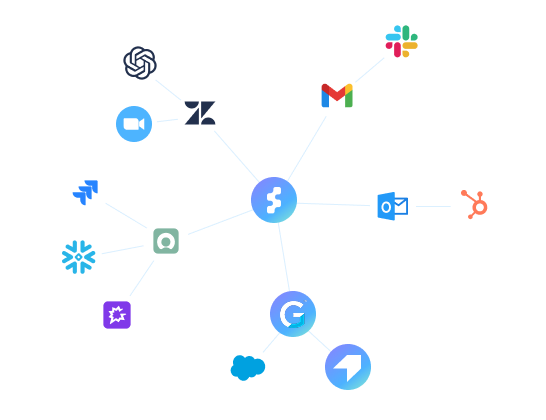
Sturdy consolidates email, tickets, chat transcripts, call transcripts and meeting notes into a single, analytic‑ready account timeline. The platform ingests omnichannel communications and fuses them with CRM and usage records to produce a unified account view, and it advertises deduplication and normalization that enable downstream analytics and tracing back to source messages [1]. A single API and source‑native backlinking permit analysts to inspect original messages underlying any detected signal, preserving auditability and context for customer conversations [1]. Sturdy documents the ability to export structured signals and stream data into enterprise BI targets such as Snowflake and Tableau, which enables RevOps and analytics teams to join Sturdy outputs with internal datasets for forecasting and measurement [1]. The platform reports processing at scale, citing billions of words across tens of millions of conversations as the corpus that informs its models, which indicates preexisting coverage of real customer interaction patterns [2]. Enterprise security controls govern those consolidated datasets, including SOC 2 Type II compliance, AWS hosting, encryption in transit and at rest, and PII redaction capabilities, supporting procurement and security review for sensitive accounts [3].
Detect and quantify revenue risk using pretrained signal models
Sturdy applies pretrained natural language models and regression logic tuned to revenue signals such as churn intent, contract inquiries, discount requests and stakeholder changes. The company states its models were developed on a large corpus of interactions and are focused on discrete, revenue‑relevant signal types rather than generic sentiment [4]. The platform reports an actionable‑signal rate of approximately 17 percent of communications, providing a quantitative baseline for expected signal volume when deployed against an account book [4]. Detected signals are aggregated into root‑cause classifications that map to product, process or people dimensions, and those aggregates feed a Revenue Risk Calculator that quantifies at‑risk ARR as an executive KPI for portfolio monitoring [5]. Across Sturdy materials, time to first revenue signal is presented as minutes after connector activation, which supports rapid validation of model outputs in a pilot context [6]. The combination of pretrained models, scale of training data, and explicit revenue quantification enables a data driven prioritization of accounts based on measurable risk exposure [5].
Trigger prioritized actions and playbooks into revenue systems
Sturdy converts detected revenue signals into prioritized alerts and automated playbook actions that integrate with CRM and collaboration tools used by account teams. The platform can create CRM tasks, surface recommended next steps and execute escalation rules into systems such as Salesforce, Gainsight, Zendesk and Slack, enabling account managers to act immediately on high priority risks [7]. Playbooks are presented as prescriptive workflows, including outreach timing and escalation paths, that are linked to detected signals so that incident response is operationalized within existing AM processes [5]. Native, bidirectional connectors allow signals and actions to flow into the revenue stack and back, which preserves a single source of truth for account state and supports coordinated interventions across sales and support teams [7]. Customer case studies report measurable outcomes consistent with rapid operational impact, including a cited 30 percent month over month retention improvement within six weeks of deployment, which demonstrates the potential for accelerated ROI when playbooks are adopted at scale [8]. Operational observability is supported through APIs and BI exports, which permit AM leaders to measure detection precision, time to escalation and retention outcomes against their pilot success criteria [1].
Sturdy addresses the core problem of detecting revenue risk by unifying signals across communications, applying pretrained revenue‑focused models to quantify exposure, and triggering prioritized, measurable actions inside existing revenue systems. The combination of analytic timelines, signal precision and automated playbooks enables account management organizations to scale proactive retention activity across large portfolios while preserving auditability and enterprise security. Key takeaways
- Consolidated, source‑linked timelines permit forensic review and BI joins for portfolio level analysis [1].
- Pretrained, revenue‑signal models deliver an expected actionable‑signal rate of about 17 percent and feed an ARR risk calculator for executive KPIs [[9]](https://www.sturdy.ai/revenue-risk-calculator).
- Automated playbooks and native connectors enable immediate CRM tasking and cross‑functional escalation, with case study evidence of rapid retention improvements [[10]](https://www.sturdy.ai/solutions/renewal-teams; https://www.sturdy.ai/case-studies/hawke-media).
References
[1] sturdy.ai • [2] sturdy.ai • [3] sturdy.ai • [4] sturdy.ai • [5] sturdy.ai • [6] sturdy.ai • [7] sturdy.ai • [8] sturdy.ai • [9] [sturdy.ai] https://www.sturdy.ai/revenue-risk-calculator) • [10] [sturdy.ai](https://www.sturdy.ai/solutions/renewal-teams; https://www.sturdy.ai/case-studies/hawke-media)
.png)