Welcome to the Sturdy Blog
News and Resources
The latest from Sturdy — product news, insights, and resources.
.png)
The Context Engine
Executive Summary
The Context Engine
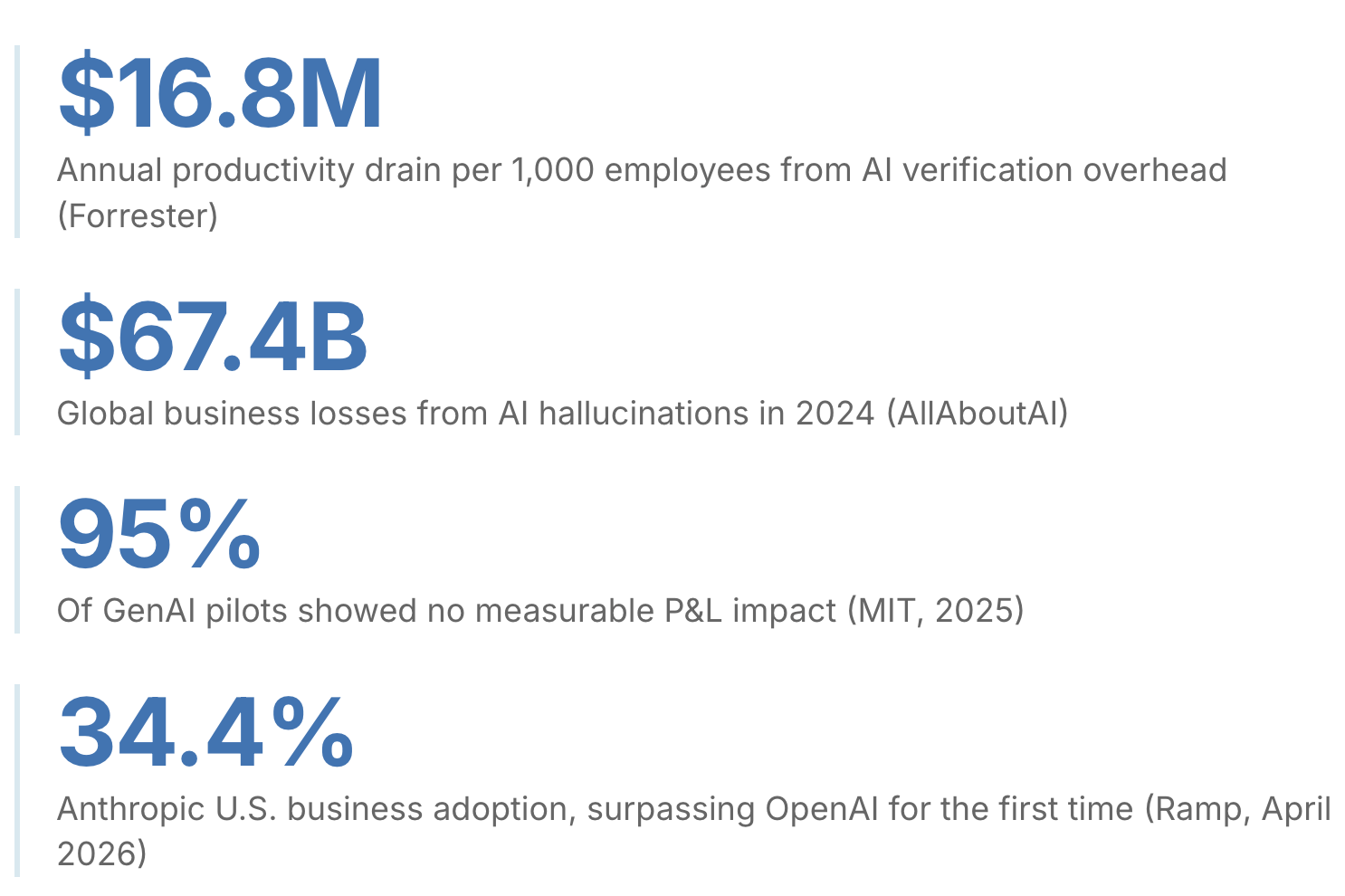
The model is not the problem. In every enterprise AI deployment that has hit a production wall in 2026, the failure lives one layer down: in how data is prepared, permissioned, and delivered before the model ever begins reasoning. Model choice has become the wrong question. With Anthropic's Claude surpassing OpenAI in U.S. enterprise adoption (34.4% vs. 32.3%, Ramp AI Index, April 2026), the market has already moved on. The competition has shifted from the Reasoning Engine to the Context Engine.
While nearly every enterprise has deployed frontier models, most are paying a Hallucination Tax they cannot see on their P&L. For an organization with 1,000 knowledge workers, the 4.3 hours per employee per week spent manually verifying AI outputs (Forrester, 2025) equates to approximately $16.8 million in annual salary drain, calculated at a conservative $75 per fully-loaded hour. Multiply that across a global enterprise, and it maps to the $67.4 billion in documented AI hallucination losses recorded in 2024 alone (AllAboutAI, 2025). This is not a failure of the model. It is a failure of architecture.
This paper argues that the next phase of enterprise AI requires a Deterministic Intelligence Layer: infrastructure that normalizes, indexes, and permissions customer data before it reaches the model. Teams replacing token-heavy RAG workflows with deterministic, pre-indexed context are seeing substantial reductions in cost per task while dramatically improving retrieval precision and AI reliability. More importantly, they are crossing the Threshold of Action: the point where AI becomes trustworthy enough to move from surfacing insights to executing workflows.
Section 1
The New Benchmark: Claude's Enterprise Breakout Moment
The AI market just had its crossover moment. As of April 2026, more U.S. businesses pay for Anthropic's Claude than for any other AI model. 34.4% vs. 32.3% for OpenAI, according to the Ramp AI Index, which tracks actual spending across more than 50,000 companies. This isn't a survey about intent. It's purchasing data.
By March 2026, Anthropic was capturing 73% of first-time business AI buyers (Axios, March 2026). A year earlier, one in 25 businesses on Ramp's platform paid for Anthropic. Today, it's nearly one in three.
Enterprise buyers don't switch defaults on a whim. They switch when something is demonstrably working better for the work they actually need done.
The Model Is Not the Problem
Here is the harder truth underneath that adoption story. Despite the crossover, most enterprise AI deployments are not delivering.
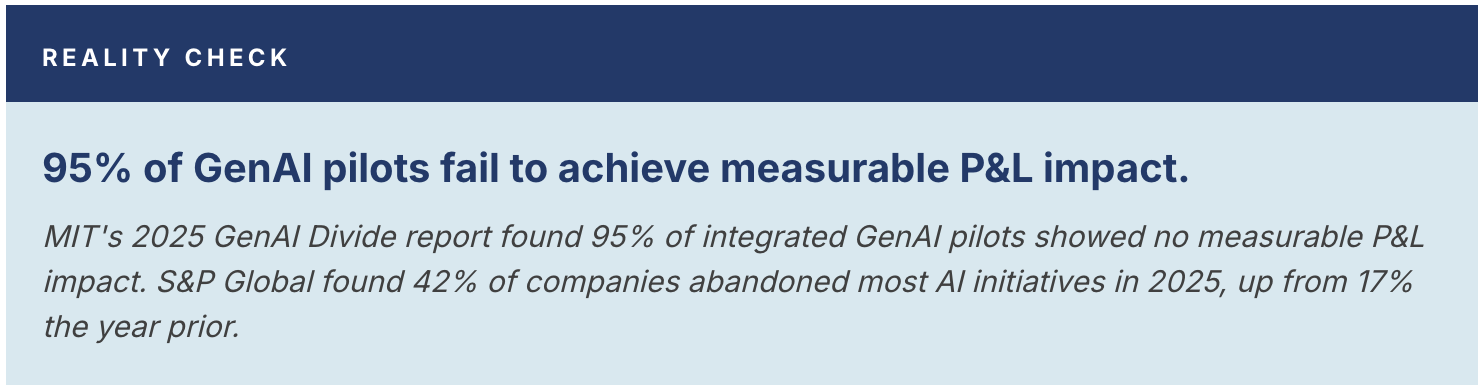
Widespread adoption. Widespread underdelivery. Both things are true simultaneously.
The instinct in most organizations is to treat this as a model problem: switch providers, upgrade to the latest version, hire a prompt engineer. None of it moves the needle in any sustained way, because the model is not where the failure lives. Claude is a reasoning engine. A sophisticated one. But a reasoning engine can only reason over what it's given. And in most enterprise deployments, what's given is a mess. Fragments.
The Performance Ceiling
Every technical leader deploying Claude at scale hits the same wall. The demo works. The pilot looks promising. Then it moves toward production, and something breaks. Not catastrophically, but consistently. The AI misattributes an item to the wrong account. It summarizes a customer's history using stale data. It generates an output that sounds authoritative and requires 20 minutes of human verification before it can be trusted.
"Feed a world-class reasoning engine confident, well-structured garbage, and you get the same in return."
This is not a failure of reasoning capability. It is a failure of context architecture. The data required to generate reliable outputs, account history, communications, support activity, call transcripts, and operational metadata typically exists across fragmented systems with inconsistent normalization, disconnected permissions, and no canonical entity resolution layer tying it together.
Context Is the New Infrastructure
The companies pulling ahead in 2026 are not winning because they chose a better model. They are winning because they solved the harder problem underneath it: delivering clean, resolved, permission-aware context before the model ever begins reasoning.
- IT, Data, and Platform Engineering provide the Engine (Claude): a recurring operating expense. World-class reasoning, rented.
- RevOps, Data, and AI Teams provide the Map (the Deterministic Data Layer): a long-term asset. Customer intelligence, owned.
Claude is the current catalyst. The model market will keep moving. New releases, new providers, new pricing. What doesn't move is the underlying problem: fragmented, unresolved, improperly permissioned data. Deterministic context is the durable architecture. The organizations building it now will carry that advantage into every subsequent model generation.
Most organizations already have the engine. What they lack is the map.
Section 2
The Hallucination Tax: Why Fragmented Data Kills AI Performance
If the model isn't the problem, why are so many production-grade AI initiatives hitting a performance ceiling? The answer is the Hallucination Tax.
In 2024, hallucinations cost enterprises an estimated $67.4 billion in global losses (AllAboutAI, 2025). By early 2026, the cost has shifted from outright fabrications to "silent hallucinations": outputs that look structurally perfect but are factually untethered from the current state of the business.
For an organization with 1,000 knowledge workers, the 4.3 hours lost per person per week equates to roughly 223,600 hours of wasted annual productivity, approximately $16.8 million in annual salary drain at a conservative, fully loaded rate. It never appears on the P&L as an AI cost. It shows up as underperformance, missed forecasts, and slower deal cycles.

This forces employees to act as "Human Middleware": the bridge between fragmented systems and the AI that was supposed to make them irrelevant. This tax is the direct result of four specific architectural failure modes.
Failure Mode 1: Retrieval Precision (The Token Tax)
Standard RAG is probabilistic. It retrieves semantically similar fragments, not operational truth. When a sales leader asks, "Why did we lose this seven-figure deal?", the system may surface an old QBR deck instead of the pricing objections in email, the procurement concerns buried in Slack, the legal escalation in Jira, and the product gaps discussed in call transcripts that actually determined the outcome.
Because retrieval is imprecise, teams over-index by stuffing the context window with every possible document to ensure the right one is in there. The result: thousands of reasoning tokens spent filtering noise. A world-class reasoning engine doing the work of a search index.
Failure Mode 2: "Lost in the Middle" (Attention Drift)
Research by Liu et al. (TACL, 2024) demonstrated that accuracy on multi-document reasoning tasks drops by more than 30 percentage points when relevant information is buried in the middle of a long context window. This matters enormously in enterprise environments, where critical signals are scattered across support escalations, pricing discussions, call transcripts, Slack threads, and CRM updates. Simply increasing context size does not solve the problem. In many cases, it amplifies it by forcing the model to attend to more noise.
Failure Mode 3: The Identity Crisis (Entity Disambiguation)
In a fragmented environment, identity is a variable, not a constant. "Jane Doe" in a Zoom transcript needs to resolve to the same Jane Doe in Salesforce, Gmail, Zendesk, Slack, and the CRM activity timeline. Without deterministic entity resolution, the model is forced to infer whether those interactions belong to the same person, account, or buying committee.
Without deterministic entity resolution, the model is forced to reconstruct identity probabilistically. A support escalation tied to one stakeholder, a pricing objection raised in a sales call, and an executive concern discussed over email may be incorrectly assembled into the wrong account narrative entirely.
Failure Mode 4: The Permission Ghost (Unauthorized Surface)
This is the silent killer of enterprise AI programs. Most RAG pipelines lack Source-System Parity. If the AI retrieves a snippet from a private executive email because it was "semantically relevant" to an intern's query, the system has failed regardless of whether anyone noticed.
Incidents like EchoLeak show exactly why retrieval-layer permission enforcement matters. In late 2025, researchers demonstrated a zero-click vulnerability in Microsoft 365 Copilot that could exfiltrate sensitive data from Copilot context without user interaction. No prompt injection required. The retrieval layer was the attack surface.
For most organizations, the permission layer isn't just a technical problem. It is an organizational liability that Legal and Security will eventually force you to solve on a deadline, under pressure, after something has already gone wrong.
The Production Wall
These four failure modes create the Production Wall. A curated demo can appear remarkably accurate. But production environments are not curated. They are noisy, fragmented, and constantly changing, with critical signals distributed across emails, calls, support threads, Slack conversations, and operational systems evolving in real time.
"You cannot solve these four problems by tuning the prompt. You have to solve them by fixing the context."

Section 3
The Deterministic Intelligence Layer
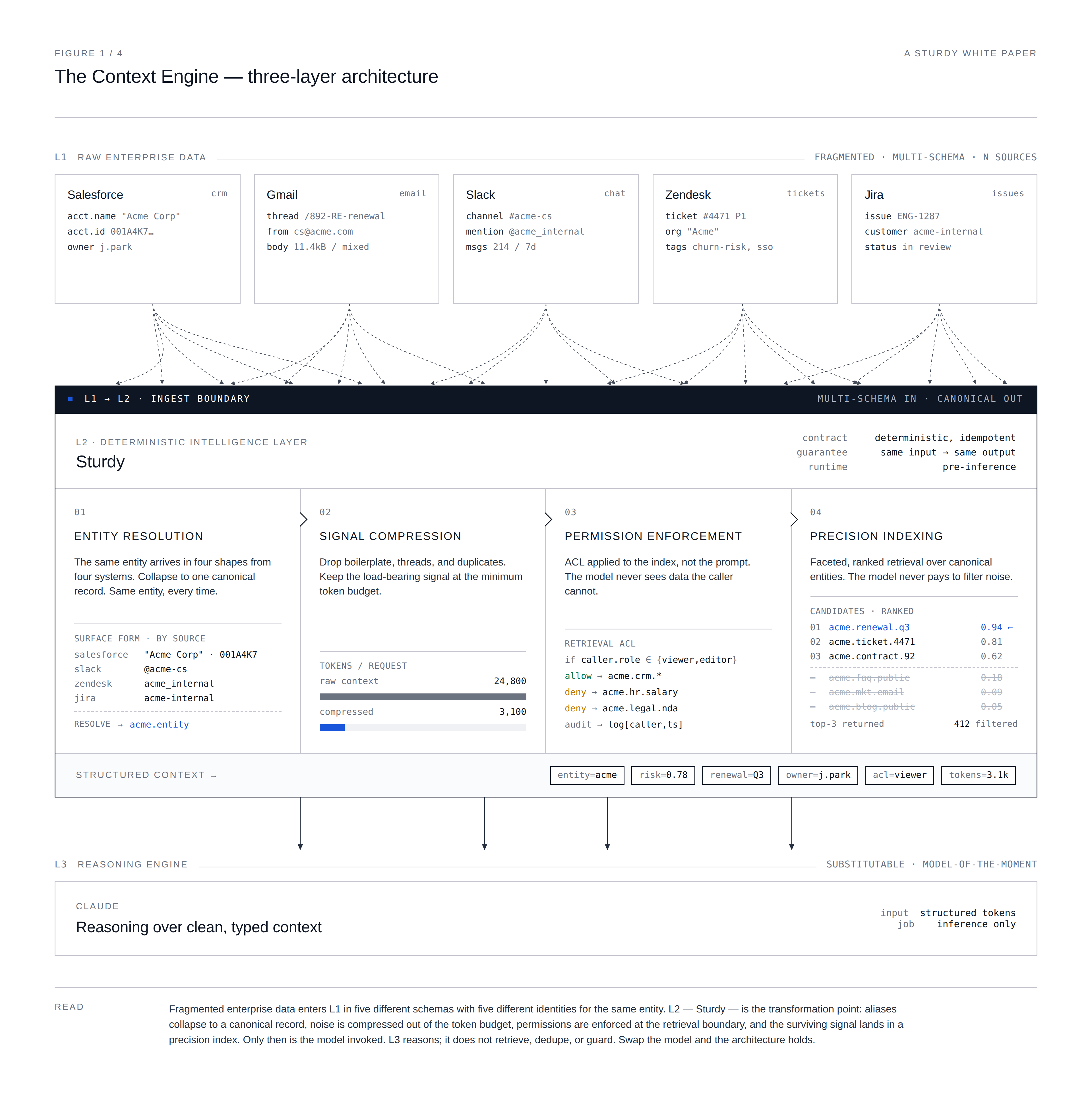
To climb over the Production Wall, enterprise architecture must evolve. The solution is not a larger context window or a more complex prompt. It is a fundamental shift in how data is prepared for the model. Enter the Deterministic Intelligence Layer: infrastructure that sits between your raw data silos and Claude, acting as the architectural antidote to the four failure modes in Section 2.
The Four Pillars
1. Precision Indexing (Ending the Token Tax)
Instead of relying on similarity search alone, the context layer resolves entities, removes duplication, and prioritizes high-signal interactions before retrieval. The model receives structured operational context rather than raw fragments competing for attention.
In Sturdy-observed deployments, replacing raw context with pre-indexed, distilled payloads has reduced token consumption by 80 to 90% on comparable workflows. Results vary by source data density and baseline architecture. You stop paying for Claude to be a search filter.
2. Signal Distillation (Solving "Lost in the Middle")
Semantic Pruning strips HTML headers, Slack noise, legal footers, and the RE: FWD: RE: reply chains that bury every actual decision in 40 lines of quoted text, distilling threads into thematic buckets: Bug Reports, Feature Requests, Sentiment Shifts. The most critical insights land at the beginning of the context window, bypassing the 30-point accuracy drop documented in long-context research.
3. Deterministic Entity Resolution (Fixing the Identity Crisis)
A Global Entity Map resolves disparate naming conventions into a single, immutable Customer ID. Claude is no longer guessing whether two conversations belong to the same account. It is being told they do.
4. Parity-Enforced Permissions (Exorcising the Permission Ghost)
The retrieval layer enforces source-system permissions before context assembly, so unauthorized records are excluded from the payload sent to the model. This is not a prompt-level instruction that can be overridden or confused. It is an architectural enforcement point that sits entirely upstream of the model.
Security becomes a structural property of the architecture, not a probabilistic instruction to the model. Incidents like EchoLeak show why this distinction matters: when permission logic lives inside the prompt, the retrieval layer remains an attack surface. When it lives at the data layer, it doesn't.
Reference Implementation: Sturdy + Claude via MCP
While the merits of this architecture are clear, building it internally results in years of maintenance debt (see Section 5). Sturdy leverages the Model Context Protocol to serve as the Context Engine for Claude, normalizing, indexing, and permission-stamping your customer intelligence layer across Salesforce, Gmail, Slack, and Zendesk before Claude ever queries it.
Claude provides the Reasoning Layer. Sturdy provides the Memory and Context Layer. Together, they move an enterprise from AI that reads your business to AI that acts on it.
Section 4
What It Unlocks: From Reading to Acting
In 2026, summarization is a commodity. The competitive advantage lies in moving from AI that reads your business to AI that acts on it. This transition requires a fundamental shift in how leadership views the AI stack and who owns what.
- IT, Data, and Platform Engineering provide the Engine (Claude): recurring operating expense. World-class reasoning, rented.
- RevOps, Data, and AI Teams provide the Map (the Deterministic Data Layer): a long-term asset. Customer intelligence, owned, not rented.
When the engine has a perfect map, the Acceleration Gap closes.
RevOps: The Revenue Architect
For the RevOps leader, a deterministic layer turns fragmented operational data into active revenue signals. Instead of building static dashboards that explain why a quarter was missed, RevOps can monitor the commercial signals that actually move deals: pricing hesitation in email, procurement delays, legal friction, competitive mentions, executive disengagement, stalled next steps, and tone changes across active opportunities.
A deterministic context layer resolves those signals to the right person, account, opportunity, and timeline before AI ever reasons over them. That is what turns scattered communication into reliable revenue action.
RevOps stops being a report generator. It becomes the operating system for revenue execution: designing the logic that turns verified commercial signals into coordinated GTM action.
Sales: Instant Account Intelligence
The average sales rep spends roughly 20% of their week on pre-call research. With a deterministic layer, the account briefing is no longer a probabilistic summary. It is a verified snapshot: "The customer's last three support tickets were resolved, but they haven't yet implemented the API update discussed in the March QBR."
Product: The Automated Feedback Loop
Product managers are often the most data-rich but insight-poor employees in the company. A deterministic layer moves PMs from reading feedback to querying insights. Claude analyzes 60 days of feedback across Slack and Zendesk and, with a single prompt, generates a high-fidelity Jira ticket including exact customer quotes, impacted account IDs, and revenue at risk.
Customer Success: Proactive Triage
In CS, latency is the enemy. A deterministic layer allows Claude to perform live triage. When a customer sends a frustrated email, the AI checks contract terms and recent product usage logs before the CSM has finished reading the subject line. It presents a Context-Aware Response ready to send, grounded in verified account data.
"The model you license today is rent. The customer intelligence layer you build is equity. One gets replaced. The other compounds."
Every account signal normalized, every entity resolved, every permission enforced. That accumulates. The organizations building this layer now are building institutional memory that makes every model they run on top of it better.

Section 5
The Build vs. Buy Reality
The instinct for most sophisticated IT and data teams is to build. It is a legitimate impulse. The stack looks deceptively simple: a few API connectors, a vector database, and some chunking logic. In the demo phase, an internal build often feels like the most cost-effective path.

The Four Hidden Engineering Hurdles
1. The Normalization Treadmill
Building a connector to Salesforce is straightforward. Maintaining the logic layer that resolves entity names across Salesforce, Slack, and Zendesk as those systems' schemas evolve is a full-time engineering job. This is Semantic Drift: hundreds of developer hours consumed by maintenance rather than innovation.
2. The Permission Mapping Paradox
Mapping row-level permissions from source systems into an AI context window is one of the most complex security challenges in modern software. Most internal builds rely on prompt-level security, which fails under the weight of incidents like EchoLeak. This isn't a technical trade-off. It is an organizational liability waiting to be forced into crisis.
3. The Latency Wall
A custom RAG pipeline often takes 5 to 10 seconds to fetch and clean data. In Sturdy-observed deployments, pre-indexed deterministic retrieval consistently operates under 1 second on production data volumes, but reaching that benchmark requires specialized search infrastructure expertise that is rarely the core competency of a generalist data team building from scratch.
4. The Token Optimization Tax
Without signal distillation, internal builds routinely pass 3x to 5x more tokens than necessary. Teams save on build costs only to spend twice as much on model API costs.
Where Does Your Engineering Dollar Go?
The strategic question isn't "Can we build this?" It's "Should we own the maintenance of this?"

Competitive advantage does not live in the plumbing. No customer chooses a vendor because their AI has a better Python script for cleaning Slack data.
By offloading the Normalization Treadmill to Sturdy, organizations are promoting their engineering teams from Data Cleaners to AI Product Owners, moving their best people away from the maintenance treadmill and toward the high-value work of building AI that drives revenue.
Buy the plumbing. Build the logic. The teams doing this are shipping revenue-generating AI workflows, while their competitors are still debugging entity-resolution scripts.
Section 6
What to Do Now: The 2026 Roadmap
The Acceleration Gap is not a permanent state. It is a choice of architecture. The move is not to wait for a smarter model. The move is to fix the context. Here are four moves for leadership to take in the next 90 days.
Move 1: Audit Your Retrieval Precision, Not Your Prompts
Most teams spend the majority of their time prompt-tuning errors caused by bad data retrieval. The action: Run a Ground Truth test. Take ten complex customer queries and manually check the data fragments Claude is being fed. If more than 20% of that data is noisy, stale, or misattributed, no prompt engineering will save the deployment. You have a plumbing problem, not a reasoning problem.
Move 2: Isolate a Multi-Source Workflow
The highest ROI for a deterministic layer is found where data is most fragmented. The action: Pick a high-value, closed-loop use case where data lives in at least three systems. For example: the path from customer feedback in Slack and Zendesk to an engineering action in Jira. Solve the context problem here, and you've built a blueprint for the rest of the organization.
Move 3: Enforce Permissions at the Data Layer
Stop treating security as a probabilistic instruction. The action: Move permission enforcement out of the system prompt and into the retrieval infrastructure. Ensure the retrieval layer enforces source-system permissions before context assembly, so unauthorized records never reach the model. The Permission Ghost is exorcised structurally, not instructionally, and the organizational liability is removed before Legal ever has to get involved.
Move 4: Define Where AI Earns the Right to Act
The distance between AI that summarizes and AI that executes is a trust gap, not a technology gap. The action: Build human-in-the-loop approval gates for high-stakes actions. Drafting a renewal contract. Creating a Jira ticket. Sending a support response. Use your deterministic layer to provide the required Confidence Equity. The threshold to target is a sub-5% error rate on AI-generated drafts. That is the point at which approval gates can be safely reduced, and workflows become self-sustaining.
Traditional probabilistic RAG architectures struggle to reach this threshold consistently at enterprise scale. Because probabilistic retrieval introduces entity errors, stale data, and permission noise, error rates on complex multi-source tasks typically stabilize in the 15 to 30% range regardless of prompt quality, even with hybrid retrieval and reranking layers added on top.
A deterministic layer that resolves entities before inference, distills the signal before retrieval, and enforces permissions before the model ever sees the data is the only architecture that makes sub-5% structurally achievable, rather than an occasional lucky outcome.
In Sturdy-observed deployments, teams that reach this threshold have consistently moved to reduced-oversight approval workflows within a quarter. Results depend on workflow complexity and baseline data quality. Reaching the sub-5% Trust Threshold is the definitive signal that an organization has graduated from "AI Experiments" to a Context Engine architecture capable of autonomous action. That is the architectural line between AI that assists and AI that acts.

Conclusion
The Architectural Advantage
Frontier models will continue to improve and commoditize. The durable advantage is no longer the model itself. It is the architecture surrounding it.
The long-term value does not live in another standalone AI interface. Interfaces change too quickly. The durable layer is the operational context infrastructure beneath them.
Organizations that solve deterministic context assembly, entity resolution, permission-aware retrieval, and operational state assembly gain a compounding advantage independent of whichever model, interface, or orchestration layer dominates next year.
Organizations that solve context architecture today are building infrastructure that compounds across model generations. As interfaces evolve and models improve, the operational context layer beneath them becomes increasingly valuable.
"The era of the Context Engine is here. Is your architecture ready for it?"

Executive Summary
The Context Engine
The model is not the problem. In every enterprise AI deployment that has hit a production wall in 2026, the failure lives one layer down: in how data is prepared, permissioned, and delivered before the model ever begins reasoning. Model choice has become the wrong question. With Anthropic's Claude surpassing OpenAI in U.S. enterprise adoption (34.4% vs. 32.3%, Ramp AI Index, April 2026), the market has already moved on. The competition has shifted from the Reasoning Engine to the Context Engine.
While nearly every enterprise has deployed frontier models, most are paying a Hallucination Tax they cannot see on their P&L. For an organization with 1,000 knowledge workers, the 4.3 hours per employee per week spent manually verifying AI outputs (Forrester, 2025) equates to approximately $16.8 million in annual salary drain, calculated at a conservative $75 per fully-loaded hour. Multiply that across a global enterprise, and it maps to the $67.4 billion in documented AI hallucination losses recorded in 2024 alone (AllAboutAI, 2025). This is not a failure of the model. It is a failure of architecture.
This paper argues that the next phase of enterprise AI requires a Deterministic Intelligence Layer: infrastructure that normalizes, indexes, and permissions customer data before it reaches the model. Teams replacing token-heavy RAG workflows with deterministic, pre-indexed context are seeing substantial reductions in cost per task while dramatically improving retrieval precision and AI reliability. More importantly, they are crossing the Threshold of Action: the point where AI becomes trustworthy enough to move from surfacing insights to executing workflows.
Section 1
The New Benchmark: Claude's Enterprise Breakout Moment
The AI market just had its crossover moment. As of April 2026, more U.S. businesses pay for Anthropic's Claude than for any other AI model. 34.4% vs. 32.3% for OpenAI, according to the Ramp AI Index, which tracks actual spending across more than 50,000 companies. This isn't a survey about intent. It's purchasing data.
By March 2026, Anthropic was capturing 73% of first-time business AI buyers (Axios, March 2026). A year earlier, one in 25 businesses on Ramp's platform paid for Anthropic. Today, it's nearly one in three.
Enterprise buyers don't switch defaults on a whim. They switch when something is demonstrably working better for the work they actually need done.
The Model Is Not the Problem
Here is the harder truth underneath that adoption story. Despite the crossover, most enterprise AI deployments are not delivering.
Widespread adoption. Widespread underdelivery. Both things are true simultaneously.
The instinct in most organizations is to treat this as a model problem: switch providers, upgrade to the latest version, hire a prompt engineer. None of it moves the needle in any sustained way, because the model is not where the failure lives. Claude is a reasoning engine. A sophisticated one. But a reasoning engine can only reason over what it's given. And in most enterprise deployments, what's given is a mess. Fragments.
The Performance Ceiling
Every technical leader deploying Claude at scale hits the same wall. The demo works. The pilot looks promising. Then it moves toward production, and something breaks. Not catastrophically, but consistently. The AI misattributes an item to the wrong account. It summarizes a customer's history using stale data. It generates an output that sounds authoritative and requires 20 minutes of human verification before it can be trusted.
"Feed a world-class reasoning engine confident, well-structured garbage, and you get the same in return."
This is not a failure of reasoning capability. It is a failure of context architecture. The data required to generate reliable outputs, account history, communications, support activity, call transcripts, and operational metadata typically exists across fragmented systems with inconsistent normalization, disconnected permissions, and no canonical entity resolution layer tying it together.
Context Is the New Infrastructure
The companies pulling ahead in 2026 are not winning because they chose a better model. They are winning because they solved the harder problem underneath it: delivering clean, resolved, permission-aware context before the model ever begins reasoning.
- IT, Data, and Platform Engineering provide the Engine (Claude): a recurring operating expense. World-class reasoning, rented.
- RevOps, Data, and AI Teams provide the Map (the Deterministic Data Layer): a long-term asset. Customer intelligence, owned.
Claude is the current catalyst. The model market will keep moving. New releases, new providers, new pricing. What doesn't move is the underlying problem: fragmented, unresolved, improperly permissioned data. Deterministic context is the durable architecture. The organizations building it now will carry that advantage into every subsequent model generation.
Most organizations already have the engine. What they lack is the map.
Section 2
The Hallucination Tax: Why Fragmented Data Kills AI Performance
If the model isn't the problem, why are so many production-grade AI initiatives hitting a performance ceiling? The answer is the Hallucination Tax.
In 2024, hallucinations cost enterprises an estimated $67.4 billion in global losses (AllAboutAI, 2025). By early 2026, the cost has shifted from outright fabrications to "silent hallucinations": outputs that look structurally perfect but are factually untethered from the current state of the business.
For an organization with 1,000 knowledge workers, the 4.3 hours lost per person per week equates to roughly 223,600 hours of wasted annual productivity, approximately $16.8 million in annual salary drain at a conservative, fully loaded rate. It never appears on the P&L as an AI cost. It shows up as underperformance, missed forecasts, and slower deal cycles.
This forces employees to act as "Human Middleware": the bridge between fragmented systems and the AI that was supposed to make them irrelevant. This tax is the direct result of four specific architectural failure modes.
Failure Mode 1: Retrieval Precision (The Token Tax)
Standard RAG is probabilistic. It retrieves semantically similar fragments, not operational truth. When a sales leader asks, "Why did we lose this seven-figure deal?", the system may surface an old QBR deck instead of the pricing objections in email, the procurement concerns buried in Slack, the legal escalation in Jira, and the product gaps discussed in call transcripts that actually determined the outcome.
Because retrieval is imprecise, teams over-index by stuffing the context window with every possible document to ensure the right one is in there. The result: thousands of reasoning tokens spent filtering noise. A world-class reasoning engine doing the work of a search index.
Failure Mode 2: "Lost in the Middle" (Attention Drift)
Research by Liu et al. (TACL, 2024) demonstrated that accuracy on multi-document reasoning tasks drops by more than 30 percentage points when relevant information is buried in the middle of a long context window. This matters enormously in enterprise environments, where critical signals are scattered across support escalations, pricing discussions, call transcripts, Slack threads, and CRM updates. Simply increasing context size does not solve the problem. In many cases, it amplifies it by forcing the model to attend to more noise.
Failure Mode 3: The Identity Crisis (Entity Disambiguation)
In a fragmented environment, identity is a variable, not a constant. "Jane Doe" in a Zoom transcript needs to resolve to the same Jane Doe in Salesforce, Gmail, Zendesk, Slack, and the CRM activity timeline. Without deterministic entity resolution, the model is forced to infer whether those interactions belong to the same person, account, or buying committee.
Without deterministic entity resolution, the model is forced to reconstruct identity probabilistically. A support escalation tied to one stakeholder, a pricing objection raised in a sales call, and an executive concern discussed over email may be incorrectly assembled into the wrong account narrative entirely.
Failure Mode 4: The Permission Ghost (Unauthorized Surface)
This is the silent killer of enterprise AI programs. Most RAG pipelines lack Source-System Parity. If the AI retrieves a snippet from a private executive email because it was "semantically relevant" to an intern's query, the system has failed regardless of whether anyone noticed.
Incidents like EchoLeak show exactly why retrieval-layer permission enforcement matters. In late 2025, researchers demonstrated a zero-click vulnerability in Microsoft 365 Copilot that could exfiltrate sensitive data from Copilot context without user interaction. No prompt injection required. The retrieval layer was the attack surface.
For most organizations, the permission layer isn't just a technical problem. It is an organizational liability that Legal and Security will eventually force you to solve on a deadline, under pressure, after something has already gone wrong.
The Production Wall
These four failure modes create the Production Wall. A curated demo can appear remarkably accurate. But production environments are not curated. They are noisy, fragmented, and constantly changing, with critical signals distributed across emails, calls, support threads, Slack conversations, and operational systems evolving in real time.
"You cannot solve these four problems by tuning the prompt. You have to solve them by fixing the context."
Section 3
The Deterministic Intelligence Layer
To climb over the Production Wall, enterprise architecture must evolve. The solution is not a larger context window or a more complex prompt. It is a fundamental shift in how data is prepared for the model. Enter the Deterministic Intelligence Layer: infrastructure that sits between your raw data silos and Claude, acting as the architectural antidote to the four failure modes in Section 2.
The Four Pillars
1. Precision Indexing (Ending the Token Tax)
Instead of relying on similarity search alone, the context layer resolves entities, removes duplication, and prioritizes high-signal interactions before retrieval. The model receives structured operational context rather than raw fragments competing for attention.
In Sturdy-observed deployments, replacing raw context with pre-indexed, distilled payloads has reduced token consumption by 80 to 90% on comparable workflows. Results vary by source data density and baseline architecture. You stop paying for Claude to be a search filter.
2. Signal Distillation (Solving "Lost in the Middle")
Semantic Pruning strips HTML headers, Slack noise, legal footers, and the RE: FWD: RE: reply chains that bury every actual decision in 40 lines of quoted text, distilling threads into thematic buckets: Bug Reports, Feature Requests, Sentiment Shifts. The most critical insights land at the beginning of the context window, bypassing the 30-point accuracy drop documented in long-context research.
3. Deterministic Entity Resolution (Fixing the Identity Crisis)
A Global Entity Map resolves disparate naming conventions into a single, immutable Customer ID. Claude is no longer guessing whether two conversations belong to the same account. It is being told they do.
4. Parity-Enforced Permissions (Exorcising the Permission Ghost)
The retrieval layer enforces source-system permissions before context assembly, so unauthorized records are excluded from the payload sent to the model. This is not a prompt-level instruction that can be overridden or confused. It is an architectural enforcement point that sits entirely upstream of the model.
Security becomes a structural property of the architecture, not a probabilistic instruction to the model. Incidents like EchoLeak show why this distinction matters: when permission logic lives inside the prompt, the retrieval layer remains an attack surface. When it lives at the data layer, it doesn't.
Reference Implementation: Sturdy + Claude via MCP
While the merits of this architecture are clear, building it internally results in years of maintenance debt (see Section 5). Sturdy leverages the Model Context Protocol to serve as the Context Engine for Claude, normalizing, indexing, and permission-stamping your customer intelligence layer across Salesforce, Gmail, Slack, and Zendesk before Claude ever queries it.
Claude provides the Reasoning Layer. Sturdy provides the Memory and Context Layer. Together, they move an enterprise from AI that reads your business to AI that acts on it.
Section 4
What It Unlocks: From Reading to Acting
In 2026, summarization is a commodity. The competitive advantage lies in moving from AI that reads your business to AI that acts on it. This transition requires a fundamental shift in how leadership views the AI stack and who owns what.
- IT, Data, and Platform Engineering provide the Engine (Claude): recurring operating expense. World-class reasoning, rented.
- RevOps, Data, and AI Teams provide the Map (the Deterministic Data Layer): a long-term asset. Customer intelligence, owned, not rented.
When the engine has a perfect map, the Acceleration Gap closes.
RevOps: The Revenue Architect
For the RevOps leader, a deterministic layer turns fragmented operational data into active revenue signals. Instead of building static dashboards that explain why a quarter was missed, RevOps can monitor the commercial signals that actually move deals: pricing hesitation in email, procurement delays, legal friction, competitive mentions, executive disengagement, stalled next steps, and tone changes across active opportunities.
A deterministic context layer resolves those signals to the right person, account, opportunity, and timeline before AI ever reasons over them. That is what turns scattered communication into reliable revenue action.
RevOps stops being a report generator. It becomes the operating system for revenue execution: designing the logic that turns verified commercial signals into coordinated GTM action.
Sales: Instant Account Intelligence
The average sales rep spends roughly 20% of their week on pre-call research. With a deterministic layer, the account briefing is no longer a probabilistic summary. It is a verified snapshot: "The customer's last three support tickets were resolved, but they haven't yet implemented the API update discussed in the March QBR."
Product: The Automated Feedback Loop
Product managers are often the most data-rich but insight-poor employees in the company. A deterministic layer moves PMs from reading feedback to querying insights. Claude analyzes 60 days of feedback across Slack and Zendesk and, with a single prompt, generates a high-fidelity Jira ticket including exact customer quotes, impacted account IDs, and revenue at risk.
Customer Success: Proactive Triage
In CS, latency is the enemy. A deterministic layer allows Claude to perform live triage. When a customer sends a frustrated email, the AI checks contract terms and recent product usage logs before the CSM has finished reading the subject line. It presents a Context-Aware Response ready to send, grounded in verified account data.
"The model you license today is rent. The customer intelligence layer you build is equity. One gets replaced. The other compounds."
Every account signal normalized, every entity resolved, every permission enforced. That accumulates. The organizations building this layer now are building institutional memory that makes every model they run on top of it better.
Section 5
The Build vs. Buy Reality
The instinct for most sophisticated IT and data teams is to build. It is a legitimate impulse. The stack looks deceptively simple: a few API connectors, a vector database, and some chunking logic. In the demo phase, an internal build often feels like the most cost-effective path.
The Four Hidden Engineering Hurdles
1. The Normalization Treadmill
Building a connector to Salesforce is straightforward. Maintaining the logic layer that resolves entity names across Salesforce, Slack, and Zendesk as those systems' schemas evolve is a full-time engineering job. This is Semantic Drift: hundreds of developer hours consumed by maintenance rather than innovation.
2. The Permission Mapping Paradox
Mapping row-level permissions from source systems into an AI context window is one of the most complex security challenges in modern software. Most internal builds rely on prompt-level security, which fails under the weight of incidents like EchoLeak. This isn't a technical trade-off. It is an organizational liability waiting to be forced into crisis.
3. The Latency Wall
A custom RAG pipeline often takes 5 to 10 seconds to fetch and clean data. In Sturdy-observed deployments, pre-indexed deterministic retrieval consistently operates under 1 second on production data volumes, but reaching that benchmark requires specialized search infrastructure expertise that is rarely the core competency of a generalist data team building from scratch.
4. The Token Optimization Tax
Without signal distillation, internal builds routinely pass 3x to 5x more tokens than necessary. Teams save on build costs only to spend twice as much on model API costs.
Where Does Your Engineering Dollar Go?
The strategic question isn't "Can we build this?" It's "Should we own the maintenance of this?"
Competitive advantage does not live in the plumbing. No customer chooses a vendor because their AI has a better Python script for cleaning Slack data.
By offloading the Normalization Treadmill to Sturdy, organizations are promoting their engineering teams from Data Cleaners to AI Product Owners, moving their best people away from the maintenance treadmill and toward the high-value work of building AI that drives revenue.
Buy the plumbing. Build the logic. The teams doing this are shipping revenue-generating AI workflows, while their competitors are still debugging entity-resolution scripts.
Section 6
What to Do Now: The 2026 Roadmap
The Acceleration Gap is not a permanent state. It is a choice of architecture. The move is not to wait for a smarter model. The move is to fix the context. Here are four moves for leadership to take in the next 90 days.
Move 1: Audit Your Retrieval Precision, Not Your Prompts
Most teams spend the majority of their time prompt-tuning errors caused by bad data retrieval. The action: Run a Ground Truth test. Take ten complex customer queries and manually check the data fragments Claude is being fed. If more than 20% of that data is noisy, stale, or misattributed, no prompt engineering will save the deployment. You have a plumbing problem, not a reasoning problem.
Move 2: Isolate a Multi-Source Workflow
The highest ROI for a deterministic layer is found where data is most fragmented. The action: Pick a high-value, closed-loop use case where data lives in at least three systems. For example: the path from customer feedback in Slack and Zendesk to an engineering action in Jira. Solve the context problem here, and you've built a blueprint for the rest of the organization.
Move 3: Enforce Permissions at the Data Layer
Stop treating security as a probabilistic instruction. The action: Move permission enforcement out of the system prompt and into the retrieval infrastructure. Ensure the retrieval layer enforces source-system permissions before context assembly, so unauthorized records never reach the model. The Permission Ghost is exorcised structurally, not instructionally, and the organizational liability is removed before Legal ever has to get involved.
Move 4: Define Where AI Earns the Right to Act
The distance between AI that summarizes and AI that executes is a trust gap, not a technology gap. The action: Build human-in-the-loop approval gates for high-stakes actions. Drafting a renewal contract. Creating a Jira ticket. Sending a support response. Use your deterministic layer to provide the required Confidence Equity. The threshold to target is a sub-5% error rate on AI-generated drafts. That is the point at which approval gates can be safely reduced, and workflows become self-sustaining.
Traditional probabilistic RAG architectures struggle to reach this threshold consistently at enterprise scale. Because probabilistic retrieval introduces entity errors, stale data, and permission noise, error rates on complex multi-source tasks typically stabilize in the 15 to 30% range regardless of prompt quality, even with hybrid retrieval and reranking layers added on top.
A deterministic layer that resolves entities before inference, distills the signal before retrieval, and enforces permissions before the model ever sees the data is the only architecture that makes sub-5% structurally achievable, rather than an occasional lucky outcome.
In Sturdy-observed deployments, teams that reach this threshold have consistently moved to reduced-oversight approval workflows within a quarter. Results depend on workflow complexity and baseline data quality. Reaching the sub-5% Trust Threshold is the definitive signal that an organization has graduated from "AI Experiments" to a Context Engine architecture capable of autonomous action. That is the architectural line between AI that assists and AI that acts.
Conclusion
The Architectural Advantage
Frontier models will continue to improve and commoditize. The durable advantage is no longer the model itself. It is the architecture surrounding it.
The long-term value does not live in another standalone AI interface. Interfaces change too quickly. The durable layer is the operational context infrastructure beneath them.
Organizations that solve deterministic context assembly, entity resolution, permission-aware retrieval, and operational state assembly gain a compounding advantage independent of whichever model, interface, or orchestration layer dominates next year.
Organizations that solve context architecture today are building infrastructure that compounds across model generations. As interfaces evolve and models improve, the operational context layer beneath them becomes increasingly valuable.
"The era of the Context Engine is here. Is your architecture ready for it?"
Our articles

Introducing Sturdy Account Views
Account views in Sturdy, the leading AI for Business platform, are specific views or displays of all the interaction data related to a particular customer account or group of accounts.
Account views are designed to provide a comprehensive and consolidated view of all interactions and touchpoints the business has had with specific customer accounts or groups of accounts. This allows cross-functional teams to better understand the customer's needs, preferences, and behaviors, which can help teams develop more targeted and effective strategies to engage, expand, and retain the account.
Account-based views in Sturdy are helpful for several reasons:
- Focused view of customer data: Account-based views provide a focused view of all the data related to a specific account or customer. This allows teams to understand the customer better and personalize their approaches.
- Better alignment of cross-functional efforts: With account-based views, sales, CX, support, product, marketing, and operations teams can work together to identify the needs and pain points of each account and develop tailored strategies to address them.
- Improved collaboration among team members: Account-based views enable teams to share information and collaborate more effectively. Having all relevant customer data in one place allows team members to communicate easily and work together, giving the customer a better experience.
- A new collective reality: Account views create a shared understanding of the customer's history, preferences, needs, situation, and requirements. This can be especially important when dealing with complex or long-term customer relationships, where multiple individuals or teams may be involved in the sales and service processes.
Overall, account views in Sturdy will play an important role in creating a shared understanding of customer accounts and helping organizations work together more effectively to meet customer needs and achieve desired outcomes.

Customer feedback: Use AI and listen to your customers, or somebody else will
Every business wants to stay ahead of the competition. We’ve got a saying here at Sturdy; “your customers are either growing with you or away from you.” And, if you think about it, you are just trying to develop a relationship with your customers to create trust and loyalty. To that end, one of the fundamental tenants of any healthy relationship is listening. Yup. It’s that simple.
One of the clearest paths to maintaining a competitive edge is simply listening to your customer’s feedback. The next step is acknowledging that their feedback matters. And the way to solidify the relationship with your customers is to implement their suggested changes in a timely manner.
At the end of the day, listening is a choice in a relationship. Whether or not you listen to your customers is up to you. But one thing is for sure. If you don’t listen to your customers, somebody else will.
Unfortunately, listening to your customers is harder than it sounds — especially at scale. We wouldn’t write this blog post about it if it were easy. While we all agree that customer feedback can give you a competitive edge, implementing the suggested changes is not always easy. After all, customer feedback is often subjective and open to interpretation. It can be hard to take a risk on an idea that may or may not pay off – especially when your competition is doing something different. But the truth is, taking customer feedback seriously and incorporating it into your everyday processes will be hugely beneficial. Not only will you gain customer loyalty and loyalty from potential new customers, but you’ll also stand out in a crowded marketplace. Taking customer feedback on board might be difficult, but it’s worth it.
You might ask, “how do I listen to my customers better?” Relying on outdated survey methodologies like NPS and CSAT can be tempting. After all, these methods have been around for a long time and are tried-and-true customer feedback techniques. But the truth is nothing is more valuable than the unsolicited, unabridged voice of the customer. Relying on tools of the past, like surveys, can mean missing valuable customer insights, alienating good customers, and wasting valuable internal resources that could be focused on more high-impact projects. As we mentioned in our previous post, 4 stars and frustrated | time to move beyond surveys and sentiment, surveys continue to fall short for many reasons:
- Surveys are a backward-looking tool in an era where customers expect near real-time remedies.
- Survey results are often ambiguous, failing to reveal the cause of customer frustration.
- Survey data is often seen as unreliable and not contextually substantive enough to drive real business impact.
- Surveys are often answered by users with exceptionally positive or negative experiences. (According to Forrester reports, surveys capture between 2% and 7.5% of customer interactions.)
- Survey responses are limited to structured questions, so respondents cannot provide feedback about topics not covered.
- Surveys require significant customer time and effort and can be considered annoying.
Don’t get us wrong, surveys can be a relatively simple and inexpensive way to collect customer feedback. But the truth is, they’re over the hill. The NPS was first published the same year the camera phone was created. Think that’s wild? The CSAT was created the same year the internet was invented. You heard that correctly, the world wide web kicked off the same year the CSAT was first administered. Feel old yet?
You might be thinking, “Okay, but what about the other methods of gathering customer feedback? What about focus groups, customer interviews, and journey mapping, for example?" Good question! These are decent ways to collect detailed customer feedback without relying on traditional questionnaires and surveys. There’s still one glaring issue, however… These methodologies are still looking through the “rearview mirror.” These reports, interviews, and maps capture what’s happened in the past. Your team needs to look forward through the “windshield” and see around the corners along the way.
Today, deploying a commercial-ready artificial intelligence solution is the key to staying ahead of customer needs and competitors. It fills in the knowledge gap between customer feedback and your team by gathering and making sense of the unbiased, unabridged, and unsolicited voice of the customer. By leveraging AI, you can gain insights that traditional customer feedback techniques simply can’t provide – like specific signals. For example, today’s AI solutions have language models that understand specific scenarios and integrate with large language models like ChatGPT to summarize what customers are saying autonomously. Surveys aren’t going to surface risks and opportunities in real-time. You and your team will have to sit down and read the results or pay someone to do it. AI is the only way to understand what best action needs to be taken in real-time.
Think about the potential application of a technology like this! This goes beyond customer success and truly impacts all aspects of a modern business. For example, AI solutions let your product team maintain product-market fit by autonomously capturing product feedback like feature requests, user confusion, frustration, etc. Customer intelligence can also discover and inspect product-related topics like performance issues, bug reports, access issues, security alerts, etc. Your RevOps and BI teams can access an entirely new structured data source to create analytical frameworks. Your marketing team can tap into your pool of happy customers for testimonials and case studies. The list goes on…
In short, customer feedback should always be taken seriously. While outdated survey methodologies like NPS and CSAT can still provide insights, these techniques should only be used to supplement more modern strategies like AI-powered resources. By taking customer feedback seriously and relying on customer-centric methods, you’ll ensure your customers grow with you, not away from you.
.avif)
Sturdy’s Executive Revenue Dashboard is in Beta
Churn is the biggest threat to growth for B2B businesses having recurring revenue models. Therefore, keeping a watchful eye on key revenue metrics like account growth and retention is critical for executives. Real-time dashboards are essential for executives as they provide visibility into their business performance. Dashboards help executives quickly gain insights into their key performance metrics and spot potential trends or issues before they become major problems.
We identified a trend after speaking with dozens of executives at customer-obsessed companies over the past year or so. Leaders and board members want key revenue metrics available with one click. They neither have the time nor the need to go into the deepest levels of data. They want a quick way to access topline revenue stats and relevant data to inform conversations with revenue teams.
The all-new Sturdy Executive Revenue Dashboard, now in beta, makes powerful revenue analysis accessible anytime. It provides a quick way for the management to visualize and understand the following:
- account growth
- cancellations
- month over month cancellation trends
- churn rate
Sturdy’s new Executive Revenue Dashboards allow execs to automatically gather, organize and analyze the revenue metrics that are most important to the organization in one simple dashboard. Benefits include:
- A concise executive revenue summary – Executives get a consolidated report of key revenue metrics in one pane of glass.
- Visualize trends – A quick and effortless way for executive management to visualize the most critical trends, including growth, monthly cancellation trends, churn rate, and retention rate.
- On-demand - With Sturdy, execs never have to wait for monthly or quarterly reports on the business's health. Access critical revenue-related trends anytime on demand with one mouse click.
Interested in learning more about how real-time revenue dashboards and churn dashboards can help executives? If so, book some time with one of our experts. During the demonstration, our expert will show you how our dashboard solutions can provide visibility into your business performance and enable you to take proactive steps toward reducing customer attrition and driving long-term growth.
.avif)
Product research gets new life with AI
Product research is a crucial component of successful software product development. By understanding customer needs, preferences, and behaviors, technology companies can create products that create value for their customers and differentiate in the marketplace. Research helps businesses learn more about their target audience and users’ desired outcomes to develop features and functionality that increase customer engagement and dependency. Let’s face it, the name of the game is getting your customers addicted to your tool or platform. In addition, software product research provides valuable data that businesses can use to optimize customer acquisition and retention motions.
Traditional product research
To date, product research has been conducted through surveys, focus groups, and customer interviews. Traditionally, surveys have been emailed to customers immediately to gather qualitative and qualitative feedback. More recently, product experience platforms have given product researchers access to more dynamic in-app surveys, product usage analytics, and the ability to launch traditional surveys with fewer resources.
Customer interviews allow one to ask specific questions and dig deeper into customer motivations, pain points, and specific use cases. Interviews can be extremely useful when businesses try to develop new products or determine how to enhance existing ones. Customer interviews can also provide valuable insights into desired integrations, services, and more.
Focus groups allow companies to observe how customers interact with products and better understand the user experience. Observing customers using the product can provide valuable insights that are unavailable through surveys or customer interviews. Additionally, observational research, such as shadowing customers in their own environment, can help uncover valuable insights that would otherwise remain hidden.
Here are a few other common ways teams conduct product research:
- Examine competitors: Analyzing competitors' products and marketing strategies can give you valuable insights into customer preferences and behavior trends in the market.
- Track sales data: Tracking sales data such as purchase histories, customer feedback, and website analytics can help you pinpoint which products are selling well and which are not so you can adjust your product design accordingly.
- Monitor social media: Utilizing social media channels like Facebook, Twitter, LinkedIn, and Instagram can help you monitor customer conversations about your product or service and see what users are saying about it.
At the end of the day, what do all of the traditional product research methods have in common? They are labor-intensive, expensive, and time-consuming, requiring intricate expertise and specialization to operate. Another drawback to traditional product research methods is that the data and insights generated are typically used by a small group and not leveraged across the enterprise.
AI is Changing How Teams Conduct Product Research
ChatGPT, the AI-powered natural language understanding (NLU) platform that helps automate conversations has catapulted AI into the business mainstream. Aside from being all the rage, business leaders are adopting AI now more than ever because of technological advancements that have made it more accurate and faster to deploy. Additionally, AI is becoming increasingly affordable, allowing businesses of all sizes to benefit from the latest advances in artificial intelligence. Furthermore, the increased availability of data has allowed for more sophisticated algorithms and models to be used, enabling better decision-making and providing a competitive edge for businesses that use AI.
Product leaders recognize that customer expectations are changing rapidly, and AI can help them stay ahead of the curve. While AI and its practical applications are evolving quickly, here are a few ways that advanced data sciences are already impacting product research.
- Automating the data capture and cleaning processes
AI automation can take over mundane tasks such as data collection and normalization (cleaning or standardizing data for reuse and analysis), freeing up teams’ time to focus on more strategic initiatives. AI also facilitates the data cleaning and preprocessing (data joining and integration) activities required to glean knowledge from the raw data.
- Eliminating privacy concerns
Privacy issues are often a roadblock for product researchers. Teams must be careful how they use personal data (PII) to discover product insights. Privacy restrictions and personal data limitations challenge legacy experimentation and research methods. AI is paving the way to alleviate these concerns so teams can move quickly. New advances in PII Identification, de-Identification, synthetic PII generation, and pseudonymization provide teams with tools to iterate and innovate faster than ever without jeopardizing privacy regulations.
- Making sense of previously untapped data sets
AI-powered platforms are making it possible to sift through data using natural language processing (NLP) and machine learning algorithms to quickly analyze large amounts of customer-generated information like email, tickets, call transcripts, and more. These data sets have, for the most part, been hard to access given, among other things, their unstructured nature. AI-based tools can search for patterns and recognize key signals that might be difficult and even impossible for humans to spot, especially at scale.
AI is already accelerating product research by enabling teams to quickly and accurately collect, clean, and identify trends in customer behaviors related to product usage and specific future use cases. AI-based platforms can analyze vast amounts of data in real time, helping companies make decisions faster while reducing costs associated with human labor. Additionally, using natural language processing (NLP), companies can automate text-based research tasks, such as discovering specific product-related insights, which would otherwise take an immense amount of time and resources. With the help of AI, teams can gain valuable insights into their products more efficiently and more effectively than ever before.
.avif)
Introducing the Discount, Costing Cutting, and Apology Signals
More Signals! More insights! More knowledge! Today, we’re excited to announce the release of three new Signals designed to help our customers better understand their customers and what to know, now. As always, the new Signals were inspired by Sturdy’s existing customers and their feedback.
Introducing the “Apology”, “Discounting”, and “Cost Cutting” Signals. Designed and built by our data engineering team, the new language models detect the following:
- When your internal teammates apologize to customers
- When discounts or price reductions are discussed with customers
- When customers ask to cut costs or reduce spend
Sturdy is the only customer intelligence platform with out-of-the-box, purpose-built language models. Adding these three new Signals brings the total number of Signals available to Sturdy customers to 23. Sturdy customers will be able to take advantage of these new Signals on Feb 15, 2023.
Apology
This Signal detects when a teammate apologizes to a customer. This Signal takes directionality into account and only “signals” on outbound interactions.
For example, when a teammate says something like, “we sincerely apologize for just getting a response out to you now,” in a support ticket, a signal is being sent. The teammate apologizes for dropping the ball. Maybe this is an isolated issue. Or, if this is a common occurrence, it could be a problem and, ultimately, detrimental to the relationship.
Discount
This signal detects when a discount or price reduction is discussed with a customer. This signal takes directionality into account and only “signals” on outbound interactions.
For example, when a teammate says something like, “I was approved to offer a 15% discount,” in an email, a Signal is sent. The teammate is providing a price reduction. Alone this may not be critical, but in the aggregate, discounting can be a bad habit for account management teams
Otherwise, Sturdy shows details about specific accounts. It’s always informative to know if any teammate has offered a customer a discount — and when, and, most importantly, why. Sturdy surfaces this information in easy-to-read dashboards, so you don’t need to wade through your CRM, CSP, or ticketing system.
Cost Cutting
This signal detects when a customer is looking to cut costs or reduce their spend. This is another directional signal that only fires on incoming interactions
For example, when a customer says something like, “We've loved the platform so much, but we are trying to reduce costs as much as possible” in an email, a signal is being sent, and often swift action needs to be taken to solidify a renewal, spot a trend, or answer questions like — what segments are asking for cost reductions, etc.
Discovering and delivering customer Signals at the right time helps teams understand what needs attention — know, now. Survey and health scores don’t give teammates the knowledge of what to do now. Signals uncovered from everyday interactions with your customers are insanely relevant — a must have. In today’s competitive SaaS environment, the most successful companies are learning to “listen” and interpret the Signals that their customers are giving them about their products and services. The category-leading companies are doing this at scale - automatically with Sturdy.
Catch your interest? Want to see how it works? Get in touch.

How to build a modern voice of the customer program
A guide to leveraging modern technology to build an actionable voice of the customer program.
Every business benefits from knowing what customers think and feel. A Voice of the Customer (VoC) program can help you capture and leverage customer insights to improve your products, processes, relationships, and bottom line. VoC programs have been in existence since the dawn of marketing. However, until recently, they were limited to gathering data through surveys, interviews, or focus groups. Most VoC programs fail because they rely on yesterday’s tools to address today’s challenges.
Surveys still fall short
Most companies still rely on surveys to gather customer insights. Sure, surveying customers sounds like a good idea. To some extent, surveys are a good starting point for obtaining information about customer experiences. But let’s face it, we all know that survey response rates are low. According to Delighted, a good survey response rate ranges between 5% and 30%. This means that your analysis through surveys represents only a fraction of your customer base, and typically, only the dissatisfied or extremely satisfied customers take the time to respond. Unfortunately, most VoC programs still rely on surveys as the number one data source to influence decisions about products, marketing campaigns, service processes, and more.
Social media monitoring - meh
While social media monitoring can be a great source of customer data and insights, it has flaws. There are several reasons why it may not always be the most reliable source for customer insights. First, as with surveys, social media users’ opinions change rapidly due to the nature of the platform. The same user may have different views or opinions at different times, which can lead to issues with reliability. Companies must ensure they are looking at a large enough sample of customers and not just basing their decisions on a few users' whims. Second, as we’ve learned from politics, all sources on social media are unreliable, and there is no way to verify their accuracy or truthfulness. VoC program managers can be misled if they rely heavily on these sources without doing extra research. And finally, as with surveys, monitoring conversations on social media is a time-consuming process. Companies must dedicate resources to this task to keep up with the latest trends and conversations about their brand or products, which can be costly in terms of both money and time.
Focus groups flop
For decades, businesses have relied on focus groups to learn more about their customers. Unfortunately, focus groups flop in many of the same ways that surveys and social media monitoring fail to deliver actionable insights. First, focus groups are typically limited in size and scope, making them unsuitable for gathering insights from a large customer base with diverse segments. Second, running focus groups is costly and resource intensive. This makes it difficult for companies with limited resources to benefit from them.
The trends to watch for when building a modern VoC program
Listen, if you rely on surveys, social media, and focus groups as the main inputs for your voice of the customer program, you are not alone. These methods are still the standard. But, there is a new trend emerging driven by advancements in technology.
Innovative businesses are starting to use traditional channels of customer feedback in combination with unsolicited feedback to gain true insights into VoC.
VoC programs have come a long way since their inception, from manually collecting data through surveys and interviews to leveraging AI-driven analytics tools today. Technology has revolutionized how organizations collect, analyze, and deliver customer insights to the teams that need them most. With modern tools and platforms, businesses can collect, analyze and leverage data on a larger scale and with greater accuracy than ever before. Here are some ways technology has changed VoC programs:
AI-driven signals
AI has revolutionized analytics tools over the past few years by allowing companies to collect large amounts of data quickly while also uncovering signals about specific customer behavior that were not possible before. Going beyond just sentiment, AI-driven signals help organizations develop strategies that meet customer needs better and lead to long-term success. But the real power of AI is to deliver the signals that are happening now — ones that can impact this quarter's results!
Automation
Before, businesses had to manually enter data into various formats and generate time-consuming and backward-looking reports. But with the combination of AI-driven insights and automation, teams can now automate processes such as collecting the unabridged, unbiased, and unsolicited voice of the customer. Automation, in this sense, reduces costs and frees up resources while increasing the speed at which teams receive valuable customer feedback.
Data integration
Modern customer intelligence platforms can combine multiple data sources to help VoC teams get perspective, providing a richer understanding of customer signals and trends from multiple channels. Using multiple data sources in combination with machine learning algorithms, companies can create more accurate models and insights than they would have been able to do with just one data source. For example, imagine having a searchable interface on top of every inbox, video call, ticket, and survey — a single pane of glass, as it were — a window into a real-time understanding of your customers’ needs and preferences.
It’s time to modernize your VoC program
The success of any VoC program depends on selecting the right tools and technologies for collecting, analyzing, and interpreting data. Companies need to consider factors such as cost-effectiveness, scalability, accuracy, and speed when building and updating VoC programs. Here are the considerations to get you started.
- Collect more relevant data sources
Don’t stop surveying, scouring social media, or conducting customer interviews. Gathering multiple data sources is key. But it’s time to add data sources. Customer intelligence technology is maturing quickly. Many of today’s systems allow you to create omnichannel customer experience insights by capturing and analyzing every customer interaction, regardless of channel (phone, email, chat, etc.).
- Analyze and interpret customer data
Once relevant data has been collected, teams must analyze it effectively to draw meaningful conclusions. This requires the effective use of AI technologies such as natural language processing (NLP) or computer vision (CV). Effective analysis helps uncover signals and patterns that wouldn’t be visible from just looking at raw numbers or statistics like the results of surveys.
- Deliver what matters - now
Finally, companies should use the signals gained from the analysis process to take actionable steps to improve their services or operations to better serve customers’ needs. This could involve implementing changes based on customer feedback or altering marketing strategies according to changing trends in customer preferences.
Overall, creating a modern VoC program is essential for businesses in today's competitive market. By understanding its fundamentals and leveraging advanced technology, companies can gain valuable insights that can help them succeed.
.avif)
The next, or the now?

I was talking with a VP of CS not long ago, and she said, “Our AMs need Sturdy to tell us what to do next.”
Since VC firms love to ask things like, “Does your product recommend Next Best Action?” and Sturdy just recently closed some funding, my judgment was cloudy…
I responded:
“Do you mean that you need Sturdy to tell your people what to do next? Like if they hear that their account had an Exec Change, then Sturdy needs to give them a playbook?”
“Uhh, no, our people know what to do next. We need Sturdy to find out what to do now….For example, if someone contacts the billing team and asks for a copy of their contract, we want the CS person to get an alert because right now, they might never even know their account is at risk.”
“Now” before “Next”.
I couldn’t help but think of all the different events that are spread out in other people’s inboxes. All of those “Nows” waiting to be found. (FWIW, we know that at least 15% of all customer conversations have some sort of “Now” in them)
More Examples
If one of your Account Managers gets an email that reads, “Hey, this feature is really confusing and annoying!” your UX Designer has a “Now!”
If a customer responds to a ticket, “That’s really disappointing, we were sold this feature, and now we’re learning it does not exist. Lame!” your Sales Team has a “Now”.
If a customer contacts your billing team and asks, “Hey, can we cancel our contract three months early?” then that customer’s Account Manager has a “NOW!”
So, what does this mean for Sturdy? Well, we need to rethink two parts of our product. First, we need to make it much, much easier to sign up for the “Nows” that are important to you. Second, we need to ensure that all those duplicate messages in inboxes, chats, cases, and tickets don’t create duplicate warnings. No noise, just Signal.
And we’re building this right now.
.avif)
Introducing the Confusion and Billing Issue Signals
We’re fired up to announce the launch of two new Signals designed to help customers gain more insights about their customers. Inspired by Sturdy’s existing customers and developed by our data engineering team, the new underlying language models detect when end users are confused and having trouble with billing-related matters.
The addition of these two new Signals brings the total number of Signals available to Sturdy customers to 20. Sturdy customers will be able to take advantage of these new Signals on Feb 1, 2023.
Confusion
This signal detects when a customer indicates that they are confused about what is happening or unsure about how to accomplish something.
For example, when a customer says something like, “we have no idea what is causing this,” in a support ticket, a signal is being sent. The customer is confused. They are asking for help. Maybe this is an isolated issue. Maybe this customer needs more training. Regardless, it’s an opportunity to engage. Furthermore, if your customers are often confused, it indicates opportunities to improve both your product and services.
Billing Issue
This signal detects when there is an issue regarding billing or payment processing.
For example, when a customer gets or responds to a message like, “this is to inform you that our attempt to collect your payment has failed”, a signal is being sent. Maybe they didn’t receive their invoice, and it’s a matter of having the wrong billing information. In this case, a simple fix is in order. Otherwise, this could indicate a larger problem associated with the relationship of the account. Or, if your company receives lots of billing issue Signals, it likely means that you have an internal process that needs to be revamped.
Discovering, classifying, and escalating customer Signals at the right time helps teams understand what needs attention — now. Move over surveys, sentiment, and health scores. This is real actionable stuff— the stuff your team needs to work on now. In today’s competitive SaaS environment, the most successful companies are learning to “listen” and interpret the Signals that their customers are giving them about their products and services. The category-leading companies are doing this at scale - automatically with Sturdy.
Catch your interest? Want to see how it works? Get in touch.

The top 13 customer intelligence platforms in 2023
Customer Intelligence (CI) has become a critical tool for organizations looking to gain a competitive edge in customer engagement and satisfaction. By collecting, analyzing, and leveraging customer data at scale, businesses can make informed decisions that will help them better understand their customers’ needs and preferences. With the rise of advanced technologies like artificial intelligence (AI), machine learning (ML), and natural language processing (NLP), customer insights have become more accessible than ever before. As a result, the number of Customer Intelligence Platforms available today proliferates, with more sophisticated tools emerging each year. This article will discuss the top 13 customer intelligence platforms in 2023 across various subcategories, such as sales intelligence, product intelligence, health score tools, productivity tools, and support intelligence.
What is Customer Intelligence?
Customer Intelligence (CI) collects and analyzes key customer-generated data to glean crucial insights, risks, trends, and opportunities. CI is heavy on integrations and often uses advanced data sciences like artificial intelligence (AI), machine learning (ML), and natural language processing (NLP).
CI is about data — some you may have already been using and new data now available thanks to technological advances. To grasp the magnitude of Customer Intelligence, imagine if you could unite and analyze all your customer interactions — emails, tickets, chats, call transcripts, and community data. Now imagine harmonizing this new knowledge stream with data in your CRM, CSPs, and usage tracking systems to create new analytical frameworks, reports, dashboards, and critical workflows. That is the essence of Customer Intelligence.
It goes without saying that core to any commercially viable CI solution is a sophisticated data privacy element. While our customers want you to use their feedback, suggestions, and more to improve the value they derive from your products and services, they also expect solutions built for the privacy-first era. They want you to fix bugs, make your product less confusing, build critical features and service them better. CI means better listening — active listening.

The proliferation of Customer Intelligence platforms doesn’t come as a surprise. Customer Experience has emerged as a top concern amongst business leaders, with more than 87% of senior business leaders indicating that customer experience is the leading growth engine for their businesses. The investment community has also taken a keen interest in Customer Intelligence-related startups pumping billions of dollars into the space in the past 48 months. The funding has been distributed across a variety of categories and line-of-business-focused segments. Let’s break CI down into a more digestible conversation.
Customer Intelligence is quickly growing into a broad category. Our research taught us that a burgeoning ecosystem of CI categories and segment-specific platforms go deep to solve unique customer-related challenges. Nearly every Customer Intelligence solution leverages advanced data sciences to provide a missing layer to today’s B2B GTM stack. Based on conversations with over 100 B2B product and customer leaders, the most beneficial systems are those that create a System of Intelligence. But no matter the application, it is clear that leaders are looking for deeper insights with which to create more durable and profitable customer relationships.
Customer and Product Intelligence

US-based Sturdy represents a strong example of an innovative, commercially-ready, Customer Intelligence solution. Sturdy collects unstructured data sources like customer emails, tickets, chats, meetings, community data, and more via public APIs. It then restructures the data while also anonymizing it to address privacy concerns. The “clean” data is combined with other data sources like CRM data and then is unified into one searchable system that every team can use. Sturdy consolidates hundreds, sometimes thousands, of data silos, then employs AI, NLP, and ML to surface essential signals and themes that help teams improve products, relationships, and revenue. The platform has a no-code automation engine and a suite of APIs (Sturdy’s Data Exhaust) to route essential data and insights to the people, teams, and systems that need them most.
CI systems like Sturdy can transform massive amounts of unstructured data (think email) into knowledge delivered autonomously to any business unit, team, person, or system. Sturdy makes insights accessible to end users and back-office analytics teams alike. Leaders are investing in AI-forward systems of intelligence because they see it as paving the path to taking customer-centricity to the next level.
Who buys Sturdy?
Customer and product leaders.
Pricing
Sturdy doesn’t list pricing on their website, stating, "Sturdy’s business plan is based on the volume of data you process and the Signals you use. We tailor our plans to best fit your needs, so please contact us for a custom quote.” It’s also worth noting that Sturdy has enterprise and SMB “quick start” plans.
Sales-Focused Solutions

The most mature category of CI products are those designed for sales and other pre-revenue teams. The leader in the space, Gong.io, has pioneered the Revenue Intelligence category, which is closely related to Customer Intelligence. Sales-focused CI solutions primarily analyze recorded sales calls for coaching opportunities and conversational insights about customer buying behaviors.
Gong makes mention that their platform can support customer success and marketing teams by focusing on moving them “closer to revenue.” Gong also can help managers use conversational insights to identify coaching opportunities for remote workers, as it seems with this entire category.
Who buys Gong.io?
Sales and RevOps Leaders at SMB and enterprise companies with significant BDR and corporate-level sales teams.
Pricing
Gong has a lot of great content on their site for sales and RevOps pros, but, like most others, they don’t provide pricing information. However, their site says pricing is based on an annual platform fee and the volume of recorded calls. Others to watch in this category are Invoca and Databook. Both are taking innovative approaches to provide sales teams with Customer Intelligence.

Invoca, like Gong.io, is a sales-focused platform that analyzes transcripts from sales calls to surface opportunities. The Invoca solution is called center-ready, and they list large customers like Verizon, Robert Half, and 1-800-Junk on their website. AI-forward technology provides the power to analyze all sales conversations, and the user interface provides multiple views of the overall prospect's journey and, often, beyond.
Who buys Invoca?
Sales, Call Center, and RevOps Leaders at B2C companies with larger agent-based, sales call centers.
Pricing
Invoca offers plans for both brands & agencies and pay-per-call marketers. They offer Pro, Enterprise, and Elite tiers in the former and Performance Professional and Enterprise in the latter. Neither list pricing on the website.

Another player in the sales-focused category is Databook. Databook provides “strategic enablement for account-based selling,” allowing teams to focus on more “doing” and less “planning.” Databook’s website classifies strategic enablement as “the art of leveraging information, process, and technology to successfully craft the strategies needed to drive effective sales execution.” This is all to say that they provide data to better inform and optimize your account-based sales process.
To accomplish this, Databook leverages its proprietary data sciences tech to analyze publicly available data. It crawls all your accounts to provide and finds and ranks prospective accounts. Databook positions itself as an Enterprise Customer Intelligence Platform — another system of intelligence — to help you close more deals.
Who buys Databook?
Sales and RevOps Leaders at B2B companies with account-based sales and marketing motions.
Pricing
Databook does not provide any pricing information on its website. You can request a free demo on their contact us page.
Support / Contact Center Intelligence
In addition to sales-focused CI, the support-focused call center category is very well represented in funding and product maturity. Companies like Observe.AI, Balto, and Forethought have raised $358MM to analyze interactions like support tickets and agent-managed phone calls. These solutions seek to reveal coaching opportunities, quality of service issues, sentiment, and compliance matters.

Observe.ai is a noteworthy solution in the Support / Call Center Intelligence subcategory. The platform analyzes agent calls and tickets. Then, using its proprietary conversation intelligence engine, it looks for what they call Moments, out-of-the-box and customer-defined themes. Consolidated views of all agent conversations and Moments give leaders good visibility into coaching/training and quality of service issues.
Who buys Observe.ai?
Call Center, Support, and Service Operations Leaders at B2C and B2B companies with larger agent-based support call centers.
Pricing
Observe.ai does not provide any pricing information on its website. Instead, the company offers live demonstrations to walk prospective customers through the platform and its features based on various use cases.

Leaders evaluating Observe.ai should also consider evaluating Balto. Balto’s conversational intelligence solutions offer benefits to agents, supervisors, and leadership with the goal of improving agent performance. Their AI enables companies to train and onboard their agents faster with prescriptive content suggestions and triggers that alert supervisors of critical moments and coaching opportunities. Balto promises to ensure that “your agents will say the right thing on every call,” real-time guidance is programmed to assist agents with the next best actions and workflows. Balto’s secret sauce is the real-time alerts that managers receive when agents need assistance allowing teams to be as proactive as possible.
Who buys Balto.ai?
Call Center, Support, and Service Operations Leaders with larger agent-based call centers at B2C and B2B companies.
Pricing
As with the norm, Balto does not provide specific pricing information but allows prospects to elect for personalized demos.
Product Intelligence
Product Intelligence is another healthy category of the Customer Intelligence space. These solutions aim to serve product and user experience teams with customer-generated insights related to product adoption and roadmap suggestions. Pendo and Aha! have been at it the longest and focus on collecting usage data and surveys. While an up-and-comer, Enterpret is building the next generation of customer feedback intelligence by leveraging the voice of the customer.

Pendo is a category leader in the Product Intelligence segment. It combines your product’s feedback, analytics, and in-app guides into one workspace. Pendo solicits and collects qualitative and quantitative data to understand customer engagement and product efficacy. With tools to impact and measure product engagement to deliver content to users at critical junctures like onboarding, Pendo is a feature-rich product intelligence solution. This maturity extends to Pendo’s commercial motions. In short, they have plans and associated feature bundles to fit small start-ups and enterprises alike.
Who buys Pendo?
Product Management, Product Operations, Product Marketing, and Operations leaders at small and large B2B and B2C companies.
Pricing
Pendo is one of the few vendors that offers detailed pricing information on their website featuring four separate plans: Free, Starter, Growth, and Portfolio. While the freemium offering allows users to get a taste of the power of Pendo, it offers a scant limit of 500 monthly active users (meaning your product users), product analytics, and in-app guides.
The Starter package increases monthly active users to 2,000 and adds their Net Promoter Score (NPS) tool. This package costs $7,000 a year. In addition to these offerings, Pendo’s Growth plan provides Sentiment analytics and can be used in a single web or mobile app. And finally, Pendo’s Portfolio package allows users to use the software across unlimited web and mobile apps. In addition to sentiment analytics, it provides cross-app reports and portfolio summaries.

Where Pendo focuses on customer feedback, Aha! provides a platform for product road mapping. More of an ideation and product creation platform for product managers than feedback analysis play, it’s a surprise to us that Aha! doesn’t integrate out-of-the-box with Pendo. Integrating Pendo data requires a Zapier integration.
The Aha! suite offers a collaborative seven-step framework for the product development process The first step establishes a clear vision and goals. The Ideate phase captures brainstorms and crowdsourced ideas. The Plan phase helps users prioritize, estimate value, and manage capacity. Showcase allows users to share roadmaps and go-to-market plans. The Build phase allows users to deliver new functionality through agile development. The Launch step brings these new features to market. Lastly, the Analyze phase allows you to see your product come to life by tracking customer usage.
Who buys Aha!?
Product Management and Engineering leaders at small and large B2B and B2C companies.
Pricing
Like Pendo, Aha! also offers a freemium option for their Aha! Create, a digital notebook for product builders. Interestingly enough, Aha! offers a free 30-day trial for its premium products. This allows users to access all features, easily invite colleagues to collaborate, and does not require a credit card upfront. Following the free trial, the Aha! Develop offers an agile tool for healthy development teams at $9 per user per month. Aha! Ideas is a comprehensive idea management tool that starts at $39 per user per month. Last but not least, the Aha! Roadmaps offering starts at $59 per user per month.

Enterpret, similar to Pendo, is building a customer feedback platform. Unlike Pendo’s approach, which leverages data from surveys and other solicitations, Enterpret looks at external reviews and internal interactions like support tickets. The platform then allows users to create and search a taxonomy to find and track product insights. Enterpret is equipped with semantic search capabilities making it easy to query keywords and topics. Their core offering aims to help teams prioritize product roadmaps, discover product gaps, and detect quality issues. The company was founded by software engineers and backed by notable investors.
Who buys Enterpret?
Product Management and Engineering leaders at SaaS companies.
Pricing
There is no pricing information available on the Enterpret site. Like many others listed above, prospective customers can fill out a demo form for more information.
Productivity Tools
Productivity-focused CI apps like Theysaid.io (FKA ‘Nuffsaid) and Retain.ai help customer success teams understand which customers need the most attention and which are black holes for your resources. For example, Theysaid.io uses a proprietary engine to prioritize tasks that matter most and log information to other systems without app-switching. This might be particularly useful to teams that use an “at scale” or “one to many” approach to manage customers.

TheySaid bills itself as a modern approach to customer success platforms. Customer interactions are consolidated in a single workspace. The analysis is done on the aggregate data to find trends. Customers are asked questions as they interact with products gathering inputs that make up quantitative trends. When a trend hits defined thresholds, workflows are kicked off. This can be particularly helpful for teams that employ a one-to-many approach.
Users of TheySaid create role-specific questions vetted by third-party experts and sent at specific times during the customer journey. Risks are then scored and given a label. TheySaid state on their website that getting started takes just a few hours.
Who buys TheySaid?
Customer Success Leaders are at SMBs that have not leveraged a traditional customer success platform.
Pricing
Although no pricing information is offered on the website, the demo form states that prospective customers can try TheySaid for free.

Like Theysaid, Retain.ai aims to create a single source of record for every customer. And, like TheySaid, getting started is quite easy. Just select what applications, workflows, pages, and attributes you want Retain.ai to track. Have your teams install a browser plugin, and the system starts tracking things like time-to-serve, engagement, team productivity, and more. Customers receive a holistic view of customer engagement across all systems view dashboards. Retain.ai has some sample case studies on its website, but it's unclear what market segment the product is geared towards.
Who buys Retain.ai?
Customer Success Leaders at B2C companies (based on their sample case studies).
Pricing
The Retain.ai website does not provide any pricing information. Those interested in learning more can fill out their demo form.
Health Score Tools
Arguably, customer health score solutions appear more as an output of Customer Intelligence than a category. These solutions target SMB buyers who haven’t adopted a more robust customer success platform. Companies like Akita and Involve.ai analyze product usage, NPS, the number of support tickets, and customer sentiment and then, with the help of data science, ascribe a health score to your accounts. Similar to Theysaid, Involve.ai takes it further by recommending playbooks once an account reaches a certain health threshold.

Akita is the go-to customer success software for SaaS businesses. Akita provides a hub for telemetry-based customer data, activity, and metrics. Beyond storing all the information, it lets customers set up unlimited alerts when certain criteria are met. Like Involve.ai, automated playbooks can be triggered in response to customer behaviors or attributes. This frees up valuable time to focus on high-value tasks. Beyond this automation lies Akita’s task management capabilities, built to provide a single and simple interface for workflows. Thinks of this as a workspace for CSMs
Who buys Akita?
Customer Success Leaders
Pricing
Akita offers three transparent pricing options. Start, Connect, and Customize offerings can be purchased on a monthly or annual subscription. Prospective customers are incentivized to go annual by saving 20% after 12 months. The Start plan offers basic features and costs $160/month (if billed annually) for up to three users. Each additional user costs $47.20 per month. The Connect Plan offers “powerful integrations for a scalable customer success strategy.” This plan costs $480 per month (again, if billed annually). Similar to the Start plan, this plan includes three users, with each additional user costing $63.20 per month. Last but not least is the Customize plan. This option requires connecting with an Akita representative to learn more about their advanced integrations. Before committing to any of these plans, however, prospective customers can test Akita out on a free 14-day trial. This free trial includes unlimited user licenses, playbooks, custom segments, and health scores.

Involve.ai touts that they’re an early warning system to predict churn and upsell opportunities. Their platform is built to help customers capture and analyze customer sentiment. After organizing and analyzing customer sentiment, Involve delivers actionable insights regarding retention, churn risk and upsell opportunities. Additionally, Involve provides customers with an actionable customer health score powered by their proprietary AI model built to analyze customers’ qualitative and quantitative data. Like Akita, Involve provides automated workflows and playbooks to maximize team efficiency.
Who buys Involve.ai?
Customer Success Leaders at SMBs that have yet to adopt a customer success platform
Pricing
Involve.ai doesn’t provide a specific pricing breakdown but a tool that hints at potential costs based on the number of clients and revenue. For example, a company with a $5MM ARR, 2% Annual Churn Rate ($100,000), and fifty customers can expect to pay $12,000 annually for Involve.ai.
By now, it’s clear that Customer Intelligence is a diverse and quickly evolving market. This list is not exhaustive. The common theme for all the systems mentioned here is data centricity. They all hinge on getting data in one place and analyzing it to provide better insights about customer behaviors.
Whether you’re already sold on the value of Customer Intelligence or looking for ways to take your customer relationships to the next level, check out these key considerations you need to know about choosing the right Customer Intelligence platform to accelerate your goals.
When choosing a CI platform, consider the following:
- Insights for various teams: Customer Intelligence isn’t just for customer success teams. Product and engineering teams can immediately benefit from learning more about customer frustration, confusion, and wants directly from the voice of the customer. Marketing teams can transform positive insights into customer references. Revenue operations and business intelligence teams can create new analytical frameworks from previously unavailable data. Choose a system that helps you democratize customer insights and one that helps to create a collective reality for every team that wants to better understand your customers.
- Fast time to value: Let’s face it, we’ve all bought platforms that were oversold, hard to implement, and even harder to administer. Look for solutions that can deliver insights to your specific use cases quickly. Understand the resources required to start receiving value and what resources are needed to maintain the program in the future.
- Tech stack: When choosing a Customer Intelligence platform, the platform you select must integrate deeply with the critical components of your current GTM tech stack. And don’t forget about customer email. More than 50% of B2B customer-to-business communications start with an email.
- Avoid duplicate functionality: CI platforms often have similar functionality to systems you already have, like customer success platforms and CRM systems. Look to compliment your existing system with rich data from a Customer Intelligence solution.
- Security: Does the platform have a clear and transparent take on data security? Ensure that any system you choose is SOC 2 Type II ready.
- Data privacy: How does the platform handle data privacy? What is the technical approach to safeguarding your customers’ PII? Will the solution meet the security and privacy requirements of your infosec and data privacy teams?
In conclusion:
We’re still in the early innings of CI. The challenges to achieving the potential are eroding as quickly as the technical capabilities are evolving, creating a new must-have system for the modern post-sale tech stack. Many organizations aren’t aware of how rapidly it’s evolving and may not realize the benefits Customer Intelligence can bring to various teams in their companies.
As we look ahead to 2023, it's clear that Customer Intelligence will continue to be one of the most essential tools businesses can use to stay competitive and understand their customers better. By leveraging customer data through CI platforms, companies are able to make informed decisions that will help them improve customer engagement and drive sales and revenue retention. They ultimately increase customer satisfaction levels across all channels to ensure your customers grow with you, not away from you.

Stop doing these 3 things now to improve your customer retention strategy
Customer retention is the ultimate force multiplier in any B2B SaaS business. It involves building strong relationships with existing customers, ensuring they stay loyal to your brand, helping them use more of your product or service, and becoming advocates who bring in more customers through word of mouth. By investing in customer retention and ultimately increasing your customers' lifetime value (LTV), SaaS businesses unlock tremendous potential for growth and profitability.
Sometimes the SaaS world seems like alphabet soup. Lots of acronyms. As a reminder, Lifetime Value (LTV) is an essential metric for SaaS businesses. It measures the profitability of a customer over their entire lifetime of their contract or subscription. LTV provides an indication of how much revenue can be expected from a customer within any given point in time.
.png)
Here’s how I suggest calculating LTV. First, determine the average revenue per user (ARPU). This is calculated by dividing total revenues by the number of users over a specific timeframe. Then, divide this result by the customer churn rate for that same period — this will estimate how long each customer’s subscription lasts on average. Multiply the ARPU and estimated lifecycle together to get your lifetime value. Doing so will allow you to accurately measure customer loyalty and help you devise meaningful customer retention strategies.
Over the course of my career, I’ve learned that sometimes the best strategy is to stop doing something rather than create a new process. Making changes and implementing new processes and workflows can be time-consuming, lead to more complications, and cause confusion for your teams and customers. Simply put, here are a few things you can do to stop pissing off your customers because we can all agree that pissing off customers is a bad strategy.
Stop ignoring customer feedback
Ignoring customer feedback is more than a mistake; it’s negligence. Customer feedback is the single most valuable thing a customer can provide — arguably more than their contract value. Insights about your products or services allow you to make improvements and create better experiences for every customer and every prospective customer.
I’ve written about the perils of relying on surveys to capture customer feedback. So as a modern business leader, it’s high time you establish the channels to capture it and share it with the teams that can benefit the most. Have a system for everyone in your organization to access and analyze customer feedback — make feedback a collective reality. Democratize it.
At one company where I served as the chief revenue officer, we provided hiring software to medium-sized employers, which helped them attract job applicants and manage the interview and hiring processes. We monitored customer feedback carefully. In fact, we monitored feedback so closely that it became a part of our culture and was more or less the genesis of my current company, Sturdy.
In addition to fielding and responding to occasional issues and concerns about how our service worked, we identified patterns within the feedback: features that were missing, UI that was confusing, bugs that caused frustrations, coaching opportunities for associates, and more. These patterns in the customer feedback informed the creation of very focused rules of engagement and playbooks that ultimately increased our LTV. This lift in LTV helped us successfully sell that business to one of the largest payroll providers in the world.
Stop overpromising
Whether the account manager said “yes” when they should have said “no,” or what they said was accurate until someone else messed it up, overpromising often comes back to haunt post-sales teams. Poorly aligned expectations leave everyone involved feeling disappointed and let down. This fracture in the customer-to-business relationship is one of the leading causes of cancellations. It’s also one that often goes undocumented or improperly categorized.
Just as important as capturing the reasons why customers cancel, customer success teams should identify and document common trends and topics that indicate overpromises. By understanding the areas where false promises are made, you can enable customer-facing teams to consistently provide accurate information about the capabilities of your product and services.
Shameless plug for Sturdy — Our AI looks for Signals of overpromises in communications with your customers. This Signal detects when a customer indicates a discrepancy between the product or service they expected and the one they received.
Here are some overpromise signals that were detected in customer-business emails. Sound familiar?
"This is something that was promised in the implementation stage."
"… even excited about the features that were promised. But do feel ... underdelivered on the capabilities."
"Below is a list of things that were promised and hasn’t happened:"
"That was promised, but I still have not received anything."
"We can't use these services that were promised/promoted."
Stop doing Silly QBRs
Ok. This may seem trivial and maybe even a little silly itself, but I can’t let this one go. For those unfamiliar with the term, a Quarterly Business Review (QBR) is a look into the performance and value of your service over the past quarter. The objective of a QBR is to identify areas of improvement and offer strategies for moving the relationship with your customer forward. As the name suggests, QBRs are typically conducted at least once per quarter and most often with a typical, boring format — a presentation on some slides. The TLDR — 95% of the time, QBRs are awful. Personally, I loathe being on either end of them.
I suggest taking a page out of Customer Success Keynote Speaker & Educator Aaron Thompson’s playbook and turning QBRs into something meaningful for your customers. Use them as an opportunity to strengthen your relationship. Don’t just go through the motions. Here are some other tips from Aaron’s blog post on LinkedIn titled “Stupid Is As Stupid Does...And QBRs Are In Fact Stupid
- Make them a conversation, not a presentation.
- Come with more questions than statements.
- Don't get into SLAs, IRTs, or anything tactical. The topic du jour is their business strategy, and you are there to learn, not to teach.
- Make them 50% retrospective and 50% prospective. 100% strategic still.
- Get Creative. Much like Spotify's #Wrapped2019 (and 2020 and 2021) campaign, they demonstrate value to their millions of subscribers at the end of each year at scale.
At several of the companies that I’ve started, advised, consulted for, and worked at, we’ve used the ‘stop, start, continue’ framework. If you aren’t familiar, the ‘stop, start, continue’ framework facilitates retrospectives. The outcome is improving future work performance through open communication and collaboration. In that vein, if you stop doing these things that damage customer relationships, you will open up the possibility of developing deeper relationships with your customers based on trust and value. Implementing even one of these changes can significantly impact your customer retention strategy. Which of these are you going to commit to first?

Your customers are already telling you what's going to happen.
Connect what customers say to why your numbers move. Contextual revenueintelligence, ready for any LLM — or running natively in Ask Sturdy from day one.